

As electric vehicles (EVs) shift from a niche market to a mainstream transportation solution, the growth and accessibility of public charging infrastructure are shaping the pace of EV adoption across the United States. With a record number of fast-charging ports added in recent years and consistent advancements in charging technology, communities and businesses alike are searching for reliable solutions. Providers such as Blink Charging commercial EV stations are helping meet the need for efficient, scalable charging networks that support a growing, electrified fleet.
The distribution and functionality of public EV charging infrastructure have progressed noticeably. Urban centers and highway corridors are seeing more robust charging options, while partnerships between public entities and private companies are pivotal in expanding accessibility. Yet persistent challenges highlight the importance of coordinated infrastructure development and equitable access, particularly for underserved populations and remote areas.
Current State of Public EV Charging
The United States has experienced remarkable growth in public EV charging infrastructure. In 2025, over 18,000 new fast-charging ports were installed, reflecting a 30 percent uptick from the previous year and bringing the national total to more than 70,000 public fast-charging sites. This expansion is particularly visible along critical corridors and in metropolitan regions, where consumer demand for reliable, high-speed charging is highest. Major automakers and energy companies have increasingly recognized the importance of charging accessibility for mainstream EV adoption. Additionally, interoperability between charging networks is gradually improving, reducing the friction for EV users who previously needed multiple apps or cards to charge their vehicles away from home. The swift pace of installation has generated considerable optimism among industry stakeholders, as reflected in reports from established sources such as Axios.
As charging networks expand, many cities are actively encouraging the integration of EV charging into existing transportation infrastructure, such as public parking garages and municipal lots. In doing so, local governments hope to make owning an EV more convenient and accessible for a broad range of drivers, including those without home charging. Some cities are also exploring on-street charging solutions, which could play a vital role in neighborhoods with dense housing. This increased visibility and convenience support a positive feedback loop in which more EV drivers enable further investment and expansion of charging services.
Challenges in EV Charging Infrastructure
Despite the rapid advancements, several notable challenges impact the deployment and usability of charging networks. Affordability and ease of use remain significant concerns; a substantial number of drivers cite the availability of public charging as a greater barrier than vehicle cost when considering a switch to an EV. Technical incompatibilities, delayed maintenance, and inconsistent payment systems create additional hurdles. Furthermore, rural areas and low-income neighborhoods often see slower charging-station rollouts, exacerbating disparities in EV adoption. An industry survey revealed these challenges persist even as automakers work to increase charger density and reliability, an issue noted in coverage by the Los Angeles Times.
Another challenge lies in the ongoing need for utilities and grid operators to manage the increased load that large-scale charging imposes on the power system. Strategic planning is necessary to ensure that utility infrastructure can accommodate spikes in demand brought on by multiple fast chargers operating simultaneously, especially during peak hours. Collaborative planning among utilities, municipalities, and charging companies is critical to avoid grid instability and ensure consistent charging availability under all conditions. These infrastructural improvements often require complex permitting, investment, and policy alignment at multiple levels of government.
Innovations and Technological Advancements
Ongoing innovation is at the heart of efforts to resolve these pressing challenges. Automaker joint ventures like Ionna are transforming the experience with integrated networks and streamlined payment systems. By mid-2026, Ionna had established 120 “Rechargery” locations in 31 states, with aggressive plans to reach 30,000 high-speed bays nationwide by 2030. These new locations offer wide stall designs, reliability guarantees, and amenities tailored to diverse customer needs, setting a new standard for the public charging experience. Additionally, advances in charger technology, such as bidirectional charging, ultra-rapid DC units, and remote monitoring, are helping address range anxiety, enhance grid integration, and facilitate faster charging times. More details on Ionna’s expansion can be found in this Axios article.
Furthermore, real-time software solutions now give drivers live updates on port status and charger availability, enabling them to plan their routes with greater confidence. The rise of networked chargers and predictive maintenance programs also helps to minimize downtime and ensure high reliability across large charging networks. There is also growing interest in integrating renewable energy and battery storage to power charging stations sustainably, which could prove integral to reducing the carbon footprint of EV infrastructure as the sector matures further.
Role of Public-Private Partnerships
The evolution and rollout of public charging infrastructure rely extensively on partnerships between governmental agencies and private-sector organizations. In 2026, Ohio launched an initiative to add 64 EV charging stations, funded by a $51 million investment spearheaded by the Ohio Department of Transportation and using federal funds allocated through the National Electric Vehicle Infrastructure program. Similar partnerships in other states and cities focus on providing consistent, equitable coverage and are crucial to sustaining the pace of infrastructure rollout. Public-private collaborative efforts enhance funding, encourage innovation, and ensure statewide initiatives align with local needs and federal sustainability goals.
Equity and Accessibility Considerations
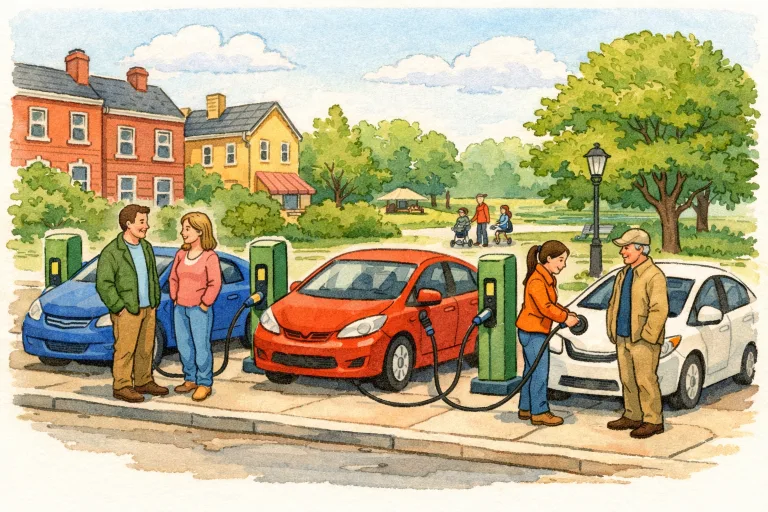
Ensuring fair access to charging infrastructure is essential for the successful, inclusive transition to electric vehicles. Research consistently finds that income, housing tenure, and geographic location contribute to disparities in EV charging availability. Low-income and minority-majority communities, as well as renters without private parking, often lack reliable access to public charging. Addressing these disparities requires deliberate policy measures, such as incentives for installing chargers in multi-family buildings and targeted investments in underserved neighborhoods, to close the gaps and allow all demographics to benefit from the electric mobility transition. More insights into these equity issues can be explored through peer-reviewed studies and analyses by energy transition think tanks.
Future Outlook and Predictions
The long-term outlook for public EV charging in the United States is exceedingly positive. Projections from energy analysts suggest the public DC fast charger sector will grow at a compound annual rate of 14 percent through 2040, with the potential to reach 475,000 ports. This expansion could generate upwards of $3.3 billion annually. As manufacturers introduce new EV models and consumer interest continues to climb, the evolution of charging infrastructure will support the wider adoption of clean transport technologies. Coordinated regulation, technological progress, and a concerted effort to address equity issues will all be vital to ensuring this promising future materializes as anticipated.
With ongoing innovation, significant investment, and collaborative action, public EV charging networks are poised to serve as the backbone of America’s clean transport future. Addressing existing barriers and prioritizing equity will be key to realizing the full benefits of electrified transportation for all.
