Business Health Score Checker
Find out the real health score of any company in just 8 questions
Key Recommendations
By: [Griffin Cottle, PhD] Assistant Professor of Management and Entrepreneurship Department of Management & Marketing
When we look at a business, we often only see the surface—the products or the storefront. However, the true "health" of a company is determined by a complex interaction of financial data, market positioning, and operational efficiency. I have designed the Business Health Score Checker to simplify these technical layers into a clear, actionable score for everyone.
Below is the technical logic behind how this tool analyzes a company’s status.
1. Operational Stability (The Foundation)
A business cannot grow if its foundation is weak. We measure stability through two main factors: Business Age and Team Size.
- Longevity: Statistically, businesses that survive past the 3-year and 10-year marks have developed "Institutional Memory." They have survived market cycles and have established fixed processes.
- Capacity: The size of the team indicates "Operational Redundancy." A sole proprietor is at high risk if they get sick; a team of 20+ means the business can function even if one person is missing.
2. Financial Vitality & Cash Flow
This is the "blood pressure" of a company. It isn’t just about how much money is coming in, but where it is going.
- Revenue Trends: We look at whether the sales are growing, flat, or declining. A declining trend is a technical red flag for "Market Irrelevance."
- Liquidity Position: Profit on a spreadsheet is different from cash in the bank. A "Strong" health score requires cash reserves that can cover at least 3-6 months of expenses without any new sales.
3. Market Positioning & Competitive Moat
A healthy company must have a "Moat"—something that protects it from competitors.
- Customer Retention: High "Churn" (customers leaving) is expensive. It costs 5x more to find a new customer than to keep an old one. Strong health scores come from high repeat-purchase rates.
- Competitive Density: We evaluate if the business is a "Price Taker" (forced to lower prices because of high competition) or a "Market Leader" (able to set prices because of a unique brand).
4. Digital Maturity (The Modern Factor)
In 2026, a business without a digital footprint is technically "Invisible" to the global economy.
- Digital Strength: This isn’t just about having a social media page. It is about "Discoverability" (SEO), "Authority" (Online Reviews), and "Engagement." A high score here indicates the business is future-proof.
5. Strategic Adaptability
The final layer is the company’s ability to change. Many famous companies failed because they stayed the same while the world moved on.
- Innovation Logic: We check for a clear growth strategy. A business that is actively innovating and planning for the next 12-24 months is technically much safer than one that is simply "surviving day-to-day."
How the Scoring Works
The Business Health Score Checker uses a weighted algorithm. Every answer is assigned a technical value based on its importance:
- High Weight: Cash Flow and Revenue Trends (These are "Leading Indicators" of survival).
- Medium Weight: Market Position and Digital Strength.
- Standard Weight: Business Age and Team Size.
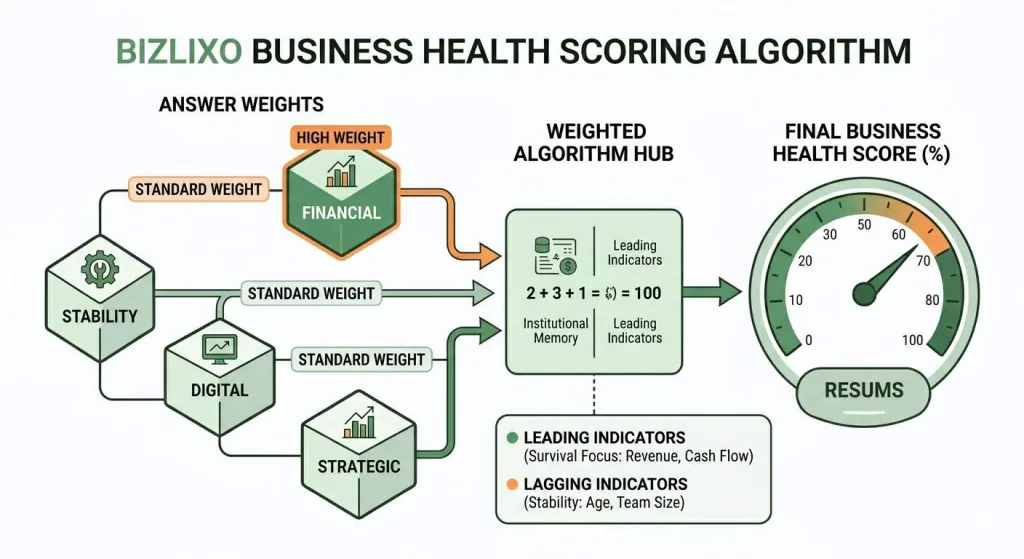
The final percentage gives you a snapshot of where the company stands today and what needs to change for a better tomorrow.
Why Use This Tool?
- For Students: To understand how professional management metrics work in the real world.
- For Entrepreneurs: To find hidden weaknesses in your own business.
- For Investors: To check the stability of a company before investing.
Take the First Step Toward Business Resilience
The difference between a business that survives and one that fails is often just data. By using the Business Health Score Checker, you aren’t just getting a number—you are getting a professional roadmap. Whether your score is high or low, knowing the truth is the only way to build a stronger future.
Expert Guidance for Your Results
- If your score is 75% or higher: You have a "Healthy Moat." Focus on scaling and expanding your market share.
- If your score is 50% to 74%: Your business is in the "Growth Zone." Identify the specific weak pillar (Financial or Digital) and strengthen it immediately.
- If your score is below 50%: Your business is "At Risk." You need to focus on core stability and cash flow management to prevent failure.
Frequently Asked Questions (FAQs)
1. Is my business data kept private?
Yes. This tool is a self-assessment calculator. We do not store your private financial figures or sensitive business secrets.
2. How often should I check my score?
Market conditions change every month. We recommend running a health check every quarter (3 months) to ensure your "blood pressure" remains stable.
3. Can I use this for a startup?
Absolutely. For startups, the tool focuses more on Strategic Adaptability and Digital Maturity to predict future success.