

Some musicians make money. Johnny Cash built a financial dynasty that keeps growing more than two decades after his death. He sold over 90 million records across five decades, never sold his catalog, and left behind an intellectual property estate that has appreciated from $60 million at death to an estimated $300 million today. The music never stopped paying. As of 2026, Johnny Cash net worth is estimated between $85 million and $300 million, with most credible financial analysts placing the current value between $85M and $100M, while legal and estate planning sources who factor in full catalog appreciation cite figures as high as $300M. In this article, I break down exactly how that wealth was built, what keeps it growing, and what his financial legacy teaches us.
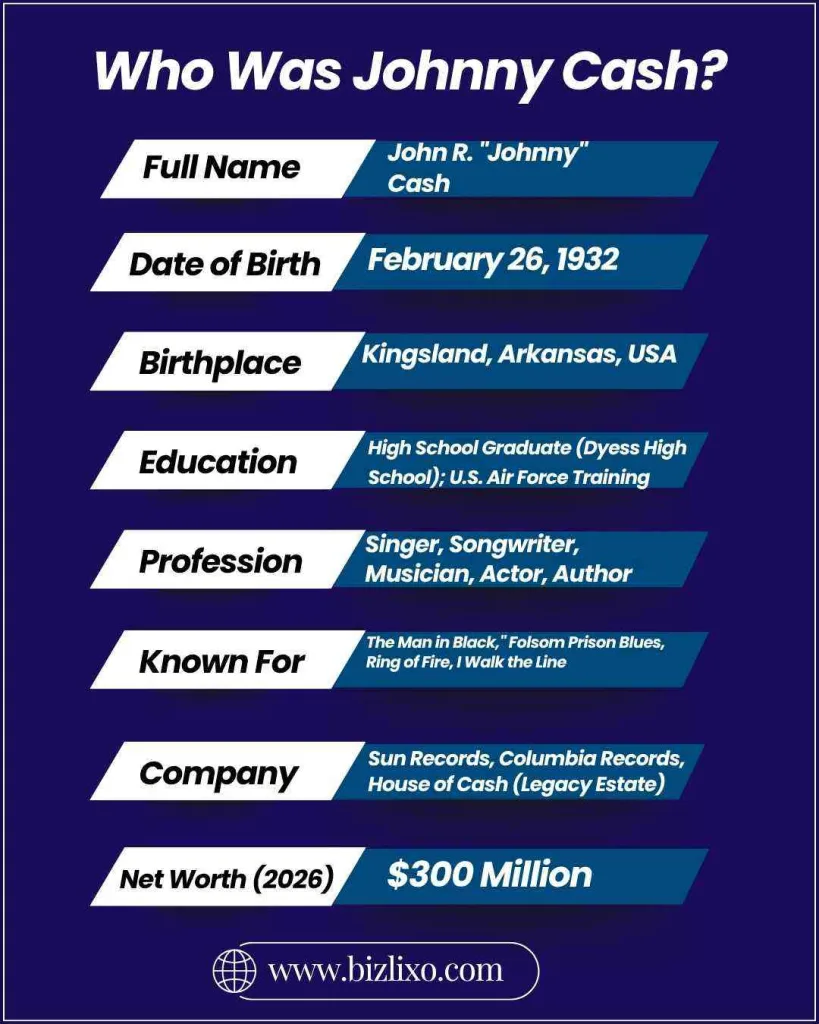
Johnny Cash Cause of Death
Johnny Cash passed away on September 12, 2003, at the age of 71. His official cause of death was complications from diabetes, which ultimately resulted in respiratory failure. In his final years, he had also battled autonomic neuropathy (a disease of the nervous system) and several bouts of pneumonia, all of which had significantly weakened his health following the death of his wife, June Carter Cash, just four months earlier.
Johnny Cash Kids
Johnny Cash had five children in total. He had four daughters with his first wife, Vivian Liberto: Rosanne (born 1955), Kathy (born 1956), Cindy (born 1959), and Tara (born 1961). He had one son with his second wife, June Carter Cash: John Carter Cash (born 1970). All five children have remained involved in the arts or in preserving their father’s immense cultural legacy.
Johnny Cash Net Worth 2023, 2024, and 2025
Between 2023 and 2025, the Johnny Cash estate has been valued at approximately $300 million. This massive figure is the result of decades of catalog management, including high-value streaming rights, physical album sales, and the licensing of his iconic image. As digital platforms continue to expand, his music—particularly the American Recordings series—generates a steady stream of passive income that places his estate among the most lucrative in country music history.
Johnny Cash Net Worth 1970
In 1970, at the peak of The Johnny Cash Show on ABC and following the massive success of his live prison albums, Johnny Cash was one of the highest-paid entertainers in the world. While exact tax records are private, his estimated annual earnings during this era were in the millions, a staggering amount for the time. His 1970 wealth was fueled by a grueling tour schedule and a television contract that made him a household name across America.If you want to learn more about successful icons, you also must visit Jill Scott net worth.
Johnny Cash Net Worth Before He Died
At the time of his death in September 2003, Johnny Cash’s personal net worth was estimated to be between $60 million and $100 million. His final years were marked by a creative resurgence led by producer Rick Rubin, which introduced his music to a younger generation through hits like “Hurt.” Just before his passing, he finalized his estate details, ensuring that the bulk of his assets and future royalties would be managed through the House of Cash legacy.
Johnny Cash Net Worth in 2026
Johnny Cash passed away on September 12, 2003. So when we discuss his 2026 net worth, we are examining estate value — the accumulated worth of his music catalog, publishing rights, intellectual property, licensing income, and associated assets.
The figures vary significantly across sources:
- Celebrity Net Worth: $60M (inflation-adjusted figure at death)
- TheRichest: $120M
- The British Report & AnniversaryMood: $85M–$90M (2026 estate estimate)
- Harvest Law KC & Busch Legal: $300M+ (full catalog appreciation since death)
The most defensible 2026 estate value is $85M–$100M in liquid and active income-generating assets, with the broader catalog and intellectual property portfolio potentially valued at $300M if a full acquisition were pursued. The difference is the accounting method: income-based valuation versus catalog market valuation.
Estate Value Growth Since Death
| Year | Estimated Estate Value | Key Driver |
|---|---|---|
| 2003 (at death) | ~$60M – $100M | Records, publishing rights, real estate |
| 2005 | ~$65M | Walk the Line biopic released — catalog surge |
| 2010 | ~$75M | Streaming platforms begin distributing catalog |
| 2015 | ~$80M | Continued streaming growth, vinyl revival begins |
| 2020 | ~$85M | Pandemic streaming surge — catalog values rise |
| 2026 | ~$85M – $300M | Active management, ongoing licensing, digital income |
Annual Estate Income Breakdown
| Revenue Source | Estimated Annual Income |
|---|---|
| Music streaming (Spotify, Apple Music, YouTube) | ~$2M – $4M |
| Publishing royalties (radio, sync, film/TV) | ~$3M – $5M |
| Johnny Cash Museum (Ticket sales + merch) | ~$1M – $2M |
| Merchandise (apparel, vinyl, collectibles) | ~$1.5M – $3M |
| Book sales and autobiographies | ~$200K – $500K |
| Licensing deals | ~$1M – $3M |
Johnny Cash Daughters Net Worth
Johnny Cash’s four daughters—Rosanne, Kathy, Cindy, and Tara—have built their own lives and careers, though their net worths vary. Rosanne Cash, the most successful musician, has an estimated net worth of $10 million in 2026, earned through her own Grammy-winning career. According to public reports of Johnny’s will, each daughter was left a direct inheritance of $1 million at the time of his death, while the ongoing royalties for many of his biggest hits were primarily directed to his son, John Carter Cash.
Primary Income Sources
When I guide people through financial analysis at Bizlixo, the Johnny Cash estate is one of the clearest examples I use of how intellectual property compounds over time without the original creator doing any additional work. Six distinct income streams keep the estate growing today — all rooted in decisions made during his lifetime.
1. Music Streaming — The Modern Royalty Engine
This is the income stream Johnny Cash never lived to see — and it may be the most significant for his estate’s long-term growth. His entire catalog is available on Spotify, Apple Music, YouTube, Amazon Music, and every major streaming platform globally.
Streaming royalty rates for legacy catalog artists average $0.003–$0.005 per stream on Spotify. With millions of streams per month — “Ring of Fire,” “I Walk the Line,” and “Hurt” each consistently accumulating hundreds of millions of plays — annual streaming income alone likely exceeds $2M–$4M. That figure grows every year as new listeners discover his catalog through playlists, algorithmic recommendations, and cultural moments.
2. Publishing Royalties — Sync and Broadcast
Every time a Johnny Cash song appears in a film, TV show, advertisement, or documentary, it generates a sync licensing fee. Every radio play generates a performance royalty. These fees are tracked and collected by performing rights organizations like ASCAP and BMI.
His collaboration with producer Rick Rubin in the American Recordings series (1994–2006) — which included the iconic cover of Nine Inch Nails’ “Hurt” — permanently elevated his catalog’s cultural standing and sync licensing value. The “Hurt” video alone triggered licensing inquiries across a new generation of advertisers and filmmakers.
3. The Johnny Cash Museum — Physical Revenue
Located in Nashville, Tennessee, the Johnny Cash Museum generates revenue through:
- Ticket sales (admission fees)
- Exclusive in-museum merchandise
- Special exhibitions and rotating collections
- Partnership events and private bookings
The Cash Cabin Studio in Tennessee provides an additional revenue node — a working professional recording studio on heritage property. Combined, the museum and studio operations generate an estimated $1M–$2M annually in direct visitor and event income.
4. Merchandise — Global Brand Sales
The “Man in Black” brand is one of the most licensable images in American music. Merchandise includes:
- Apparel (T-shirts, jackets, accessories) — sold globally
- Vinyl reissues — a growing revenue stream as vinyl sales have surged since 2017
- Collectibles and limited editions
- Official partnerships with apparel brands
Annual merchandise revenue is estimated at $1.5M–$3M, driven by fan demand that has not declined since his death and has arguably grown with each new generational rediscovery.
5. Book Sales — Ongoing Autobiography Income
Cash authored two autobiographies: Man in Black (1975) and Cash: The Autobiography (1997). Both remain in print and are actively selling. Autobiography sales for legacy artists are a surprisingly durable income stream — new biographers, documentary viewers, and fans consistently return to primary sources, keeping backlist sales consistently active for decades.
6. Licensing Deals — Film, TV, and Advertising
His music and image are licensed for use in major productions, advertisements, and documentaries. Walk the Line (2005) — the biopic starring Joaquin Phoenix and Reese Witherspoon — reignited global interest in his catalog and permanently elevated licensing rates. Every new production referencing his life or music generates fresh fees.
Expenditures and Business Ventures

Estate Management — Professional Administration
The Cash estate is managed professionally by John Carter Cash and a team of estate administrators. Active management decisions include:
- Controlling which licensing requests to accept or decline
- Managing reissue and remaster programs
- Approving or rejecting commercial uses of the Cash image and name
- Overseeing the museum’s operations and brand partnerships
Deliberate restraint is the defining strategy. The estate has consistently declined to over-commercialize the Cash brand — a decision that preserves long-term brand integrity and prevents the dilution that has hurt other legacy estates.
The Ring of Fire Inheritance Dispute
The most significant financial dispute in the estate’s history centered on “Ring of Fire” — co-written by June Carter Cash, Merle Kilgore, and Johnny Cash. The publishing rights passed to John Carter Cash upon his parents’ deaths. His four half-sisters (Cash’s daughters from his first marriage to Vivian) sued for a share of the royalties in the mid-2000s. They lost the case in 2007, leaving John Carter Cash as the sole controlling party for these publishing rights.
This dispute is now resolved and represents a cautionary tale in estate planning — one of the most cited examples in the estate planning industry of how unequal inheritance structures in blended families generate costly litigation.
Real Estate Holdings
During his lifetime, Cash owned:
- A 6-acre property in Casitas Springs, California (purchased in the 1960s, sold after divorce — the same property listed at $1.795M in 2022)
- A 14,000 sq ft lakefront mansion near Nashville, Tennessee (acquired in 1968, destroyed in a 2007 fire, sold for $3.2M in 2020)
Real estate no longer represents an active asset in the estate — all primary properties have been sold. However, the Cash Cabin Studio property in Hendersonville, Tennessee remains operationally active.
Lifestyle — How Cash Lived During His Peak Earning Years
During his lifetime, Cash’s lifestyle reflected the contradictions that made his music resonate.Before you dismiss or accept any number, let me break it down properly for you just like the Lillo Brancato Journey.
- He maintained the 14,000 sq ft lakefront mansion with June Carter Cash near Nashville as their primary residence for 35 years
- He was known for wearing all black on stage — a deliberate, permanent wardrobe choice that became one of the most recognizable artist visual identities in history
- He battled addiction to amphetamines and barbiturates throughout the 1960s before achieving sobriety with June Carter Cash’s support after they married in 1968
- He performed live at Folsom State Prison (1968) and San Quentin State Prison (1969) — concerts that produced two of the best-selling live albums in music history and cemented his standing as an artist of genuine social conscience
- He and June Carter Cash died four months apart in 2003 — June in May, Johnny in September — their combined estate at the time valued at approximately $80M
Key Lessons from Johnny Cash’s Wealth Model
I study estates like Johnny Cash’s because they reveal the most important financial principles in creative wealth-building — principles that apply equally to any business building long-term asset value.
- Never sell your catalog. Cash never sold his master recordings or publishing rights during his lifetime. That decision preserved 100% of the upside for his estate and his family. In contrast, artists who sell their catalogs receive a one-time payment and forfeit decades of future royalties. The compounding difference is worth hundreds of millions.
- Intellectual property appreciates indefinitely. A song written in 1956 is worth more in 2026 than it was in 1990. Every new film, streaming platform, and cultural moment that features it increases its value. IP is the only asset class with no depreciation ceiling.
- Brand restraint protects long-term value. The Cash estate has consistently rejected low-quality licensing requests. That selectivity keeps the brand premium — which keeps licensing fees high. Over-licensing is the fastest way to destroy a legacy brand’s commercial value.
- Streaming transformed legacy catalog economics. Cash died eight years before Spotify launched. Yet his catalog now earns millions annually from platforms that did not exist during his lifetime. Legacy catalog artists who retained rights have benefited more from streaming than many active artists.
- Estate planning is as important as wealth building. The Ring of Fire dispute cost the estate years of litigation and family conflict. Proper estate planning — specifically, clear intellectual property clauses and trust structures for blended families — could have prevented both the legal costs and the family damage.
- Cross-genre appeal multiplies lifetime earning potential. Cash earned inductions into both the Country Music Hall of Fame and the Rock & Roll Hall of Fame — the only artist to achieve both. That dual credibility doubled the licensing market for his music, reaching country audiences and rock audiences simultaneously.
Final Thoughts
Johnny Cash’s $85M–$300M estate value in 2026 is the result of 50 years of artistic output, smart catalog ownership decisions, and post-death estate management that has grown the original inheritance rather than depleted it. He did not build a tech company or a real estate portfolio. He built songs — and he kept them.
Before you model any business or creative career strategy on someone else’s financial legacy, understand the actual mechanics behind the wealth. At Bizlixo, that structured financial analysis is exactly what I help people do before committing to any path.